
When the world shakes, Nigeria bleeds
The current escalation of the United States with Israel and Iran is a textbook example of how the contemporary war can be transformed into an energy shock in a few hours. To reprice petroleum, markets only require a plausible threat to supply routes, insurance, refinery, or even export terminals, but no actual scarcity.
In early March 2026, that risk premium surged hard. Covering the war and its effects, Reuters recorded a sudden, war-induced explosion of prices above $100, and an equally incredible decline later after political signs of possible de-escalation- another demonstration of how quickly headline risk transforms into pricing risk.
Other outlets described the same volatility: Brent crude briefly touched levels near $120 per barrel before retreating. The root cause reported in all the sources is the same: fear of continued destabilisation in major output areas and bottlenecks, particularly the Strait of Hormuz area that links Gulf exporters to the global markets.
To most crude exporters, an increase in the price of crude can broaden fiscal space, at least in the short run. However, in the case of Nigeria, the oil nation that imports refined fuels and runs millions of engines on petrol and diesel, a world-price surge is not acting like a windfall but more like a mass tax on life.
Why fuel volatility hits Nigeria like a tax on living
Nigeria’s vulnerability is not mysterious. It is structural:
First, a significant portion of everyday life and business is run on refined products of petroleum, not merely by means of transportation, but by self-generation. The extent of this dependence was reflected in a World Bank project document, which estimated some 22 million gasoline/diesel generators serving approximately 26 percent of households and 30 percent of micro, small, and medium enterprises (MSMEs) with vast sums of money tied up in the generator economy.
Second, price cushioning was radically reduced when the federal government ended the long-standing PMS (petrol) subsidy regime in 2023. The decision was framed as necessary to reduce fiscal leakage and reposition the economy; it also came with promises of mitigation through alternative transport and energy plans.
Third, once fuel is priced closer to market realities, global volatility transmits faster into local hardship, especially in an economy where logistics costs and energy insecurity are already high. Put plainly: in countries with reliable grid power and strong public transport, fuel is “important.” In Nigeria, fuel is “foundational.”
That is why the current war’s ripple is visible at the pump almost immediately.
On March 9, 2026, Dangote Petroleum Refinery raised its ex-depot (gantry) price of Premium Motor Spirit (PMS) to ₦1,175 per litre, reported as the fourth revision within less than two weeks, while diesel was also raised to ₦1,620 per litre.
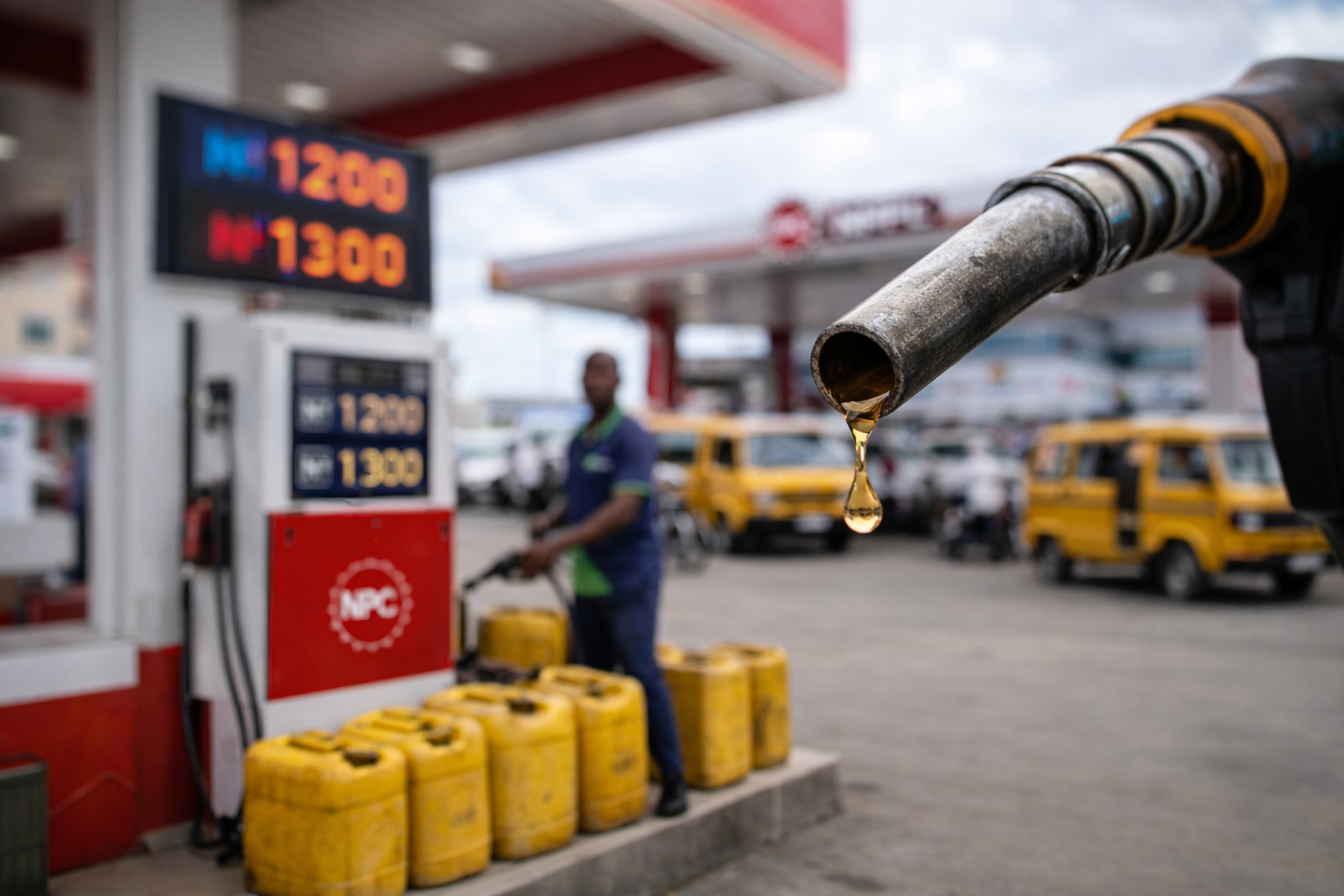
In hours and days, retail prices varied in cities and corridors in terms of transport costs, depot factors, and the margins of marketers. A nationwide report spoke of selling petrol within the N1,200 to N1,300 in portions of Ibadan and N1,250 in Abuja at certain locations, with Lagos also experiencing a widespread upward trend.
This speed of pass-through is why Nigerians experience fuel price hikes as immediate inflation: transport fares rise, food distribution costs rise, and the generator economy becomes more expensive at precisely the moment households and small businesses are least able to absorb it.
It is also why blaming a single refinery for Nigeria’s pain is incomplete. Even pro-market analysts emphasized that domestic refining can improve supply security, but it does not automatically delink local prices from global crude benchmarks, especially when crude feedstock itself is valued at international benchmark prices (even if settled in local currency under special arrangements).
This speed of pass-through is why Nigerians experience fuel price hikes as immediate inflation: transport fares rise, food distribution costs rise, and the generator economy becomes more expensive at precisely the moment households and small businesses are least able to absorb it.
It is also why blaming a single refinery for Nigeria’s pain is incomplete. Even pro-market analysts emphasized that domestic refining can improve supply security, but it does not automatically delink local prices from global crude benchmarks, especially when crude feedstock itself is valued at international benchmark prices (even if settled in local currency under special arrangements).
The refinery ghost and the accountability gap
For years, Nigerians have been told that revamping state-owned refineries would end this cycle. The spending trail is real—and so is the disappointment.
In March 2021, the Federal Executive Council approved $1.5 billion for the rehabilitation of the Port Harcourt refinery complex. In August 2021, the Federal Executive Council approved about $1.484 billion for the rehabilitation of the Warri and Kaduna refineries.
Contracting milestones were publicly celebrated. Tecnimont announced mechanical completion of rehabilitation works for an “old plant” area within the Port Harcourt complex in late 2023 and described the broader project aim as restoring the complex to a minimum of 90% of nameplate capacity.
But in practice, the refineries did not deliver stable, high-volume refining that Nigerians can feel at the pump. Quoting the ‘National Petroleum Company Limited leadership’ described the Port Harcourt refinery as having reopened in November 2024 but then shutting again in May 2025 amid sustained losses, raising questions not only about engineering outcomes but about operational economics and governance.
International reporting reinforces the same theme: Nigerian National Petroleum Company Limited has acknowledged major operational and management problems across its refineries and has explored new partnership structures—moving away from repeated contractor cycles toward bringing in experienced operators as equity partners, because internal reviews revealed persistent losses and minimal output.
Meanwhile, the long-run spending argument escalated beyond “$3–$4 billion.” In late 2025, Nigeria’s House of Representatives resolved to investigate claims that over $18 billion had been spent over roughly two decades on rehabilitation/turnaround maintenance of state-owned refineries with little to show in sustained output.
That $18 billion figure has become a national symbol of failure, popularized by prominent voices and repeated in media coverage, yet it is also contested, with some analysts warning that the number is disputed and that any credible audit must trace spending comprehensively across administrations and reporting systems.
The takeaway for a Nigerian energy reset is not merely “we spent money and got nothing.” The deeper lesson is governance: repeated capital injections into the same assets without transparent performance metrics, public contracting clarity, and enforceable accountability will keep producing the same outcome: more announcements, more “completion,” more losses.
The constitutional opening for state power and why Aba matters
Nigeria’s most underused “shock absorber” is not crude oil. It is electricity.
A major constitutional change in 2023 expanded state authority by removing language that had constrained states’ ability to legislate electricity in areas “not covered by a national grid system.” In effect, the change opened space for more decentralized electricity markets and state-level action.
The Electricity Act 2023 then built an operational framework around that constitutional shift. It explicitly protects state laws and actions across the electricity value chain within state boundaries; generation, transmission (where applicable), distribution, supply, retail, and it recognizes state electricity markets and state regulators.
Crucially, the Act also sets out a pathway for transition: a state can enact a law to establish a state electricity market, set up a state electricity regulatory authority, and then request the transfer of regulatory authority over electricity operations in the state, supported by a timeline and procedural steps.
This is not theoretical. By early 2026, Nigerian Electricity Regulatory Commission described Nigeria as moving into a multi-regulator environment and referenced transfer orders issued to multiple states, an institutional marker that decentralization has begun to move from paper to implementation.
That institutional shift matters for fuel prices because electricity reliability directly affects fuel demand. When power is unreliable, households and enterprises spend heavily on petrol/diesel self-generation. When electricity becomes reliable, the generator economy shrinks, and fuel price shocks become less deadly.
This is why the Abia State example is strategically important.
The Geometric Power Aba Integrated Power Project is designed as a ring-fenced, vertically integrated generation-and-distribution model serving nine local government areas within the Aba ring-fenced zone, with an ultimate ambition of near-24-hour supply.
Afreximbank’s development impact evaluation describes a 188 MW licensed generation capacity, the coverage across nine LGAs, and the project’s commissioning timeline in February 2024, positioning it as a blueprint for what can happen when a defined commercial/industrial cluster is prioritized with embedded power infrastructure and ring-fenced distribution.
The policy lesson is simple: if multiple states build credible “industrial ring” electricity models, focused first on dense SME corridors and manufacturing clusters, Nigeria can reduce nationwide generator dependence faster than any rhetorical subsidy debate. And that is how you reduce the power of global wars over local survival.
A seven-point emergency plan for shock-proofing Nigerians
Outlined below is a practical blueprint for how a government that takes energy security seriously could reduce Nigeria’s exposure to global fuel shocks. Each point is designed to either (1) reduce the price pass-through, (2) reduce demand vulnerability, or (3) reduce the governance failures that keep Nigeria trapped.
1. Mandate a transparent naira-based domestic crude framework, without pretending it is “cheap crude.”
Nigeria has already experimented with naira-settled crude arrangements for domestic refining. Reporting documented the naira-based crude supply deal and the challenges of aligning naira sales with dollar-denominated crude procurement, including moments when the refinery suspended naira sales due to mismatch.
A realistic policy would acknowledge what analysts and industry voices have stressed: even under “crude-for-naira,” valuation often tracks international benchmarks, meaning it is not automatically a discount.
The reset would therefore be about transparency and stability: publish the formula (benchmark reference, logistics, quality differentials, FX settlement rules), publish allocations, publish volumes, and remove discretion that creates corruption rents.
2, Create a State Grid Acceleration Fund tied to the Electricity Act transition pathway.
Electricity decentralization is now legally feasible and procedurally mapped.
A federal fund should match states’ credible ring-fence projects, especially where they target industrial clusters, markets, and SME corridors, because those are the areas where generator fuel demand is highest and where productivity gains pay back fastest. The generator economy is not small; the World Bank describes tens of millions of generators and large macroeconomic losses from unreliable power.
Funding should also be conditioned on measurable outcomes (hours of supply, feeder uptime, metering coverage, loss reduction), with independent verification and penalties for non-performance.
3. Replace blanket fuel subsidy logic with a “Logistics Shield” that protects food inflation.
When fuel prices jump, food inflation accelerates because transport costs rise through the entire distribution chain.
Instead of subsidizing petrol for everyone (which often benefits higher-income consumers disproportionately), Nigeria can target the narrow channel that most directly determines welfare: food logistics. This approach mirrors the global shift toward “better targeted” subsidy designs and compensations.
Internationally, the policy idea is not radical: Indonesia has explicitly used its state budget and energy subsidy allocations to absorb shocks from rising oil prices, aiming to protect consumers from immediate pass-through.
Nigeria’s version should be digital (registered transporters, route/commodity verification, time-bound rebates) to reduce fraud and ensure that the purpose, preventing fuel hikes from becoming food hikes, is achieved.
4. Audit the “cushion promises” with public receipts, not slogans.
When subsidy was removed, the government announced mitigation measures, including alternative transport initiatives. One report described plans that included purchasing thousands of CNG vehicles/tricycles and a tranche of electric buses under a palliative framework.
A serious reset would publish what was promised, what was funded, what was procured, what was delivered, and where each asset is operating, state by state, because trust collapses when Nigerians hear “palliatives” but experience only price increases.
This same accountability principle must apply to refineries: the House of Representatives’ refinery spending probe exists for a reason, and it should conclude with verifiable findings, not just headlines.
5, Adopt the NLNG governance lesson: keep public interest, remove political operations.
One of Nigeria’s most cited energy-sector successes is Nigeria LNG Limited, a joint venture structure with diversified ownership, including the national oil company alongside international partners, rather than full political control.
The lesson is not that every asset must be privatized. The lesson is that operational discipline and corporate governance matter. For refineries, the path should be equity partnerships or transparent concessions with experienced operators, exactly the strategic pivot Nigerian National Petroleum Company Limited itself has discussed in seeking technical equity partners to revive loss-making refineries.
6. Launch an emergency solar and mini-grid credit line for SMEs and markets.
This is the fastest way to decouple Nigeria’s “hustle economy” from the petrol nozzle. A World Bank document quantified the generator burden: tens of millions of generators, billions of dollars in annual spending, and large GDP-scale losses from unreliable electricity.
Nigeria has the policy tools and partnerships to scale distributed power: international reporting highlighted a $200 million deal framework to deploy renewable mini-grids for millions of people, aligned with the role of the Rural Electrification Agency and private-sector delivery models.
A practical emergency program would combine concessional finance (low interest), quality standards, and verified productive-use deployment (cold rooms, clinics, small manufacturing, markets), because the goal is not just “green,” but cheaper and more reliable energy than generators.
7. Build a strategic petroleum products buffer that targets refined fuels, not just crude.
Countries with real resilience hold strategic stocks and can release them when supply disruptions threaten domestic stability. For IEA members, the benchmark obligation is at least 90 days of net imports, backed by clear emergency response mechanisms.
Nigeria has already discussed building a larger national strategic petroleum products stockpile; reporting quoted the downstream regulator describing plans and noting that the existing reserve covered about 30 days of supply at the time, with a new reserve intended to be significantly larger.
The reset is to get specific: define the target (e.g., 60–90 days of refined products), define storage governance (public + licensed private depots), define rotation rules (to prevent quality degradation), and define release triggers (price spikes, freight disruptions, war risk, pipeline sabotage).
What resilient countries do differently and what Nigeria can copy
Energy resilience is not a moral virtue. It is a toolkit.
One tool is strategic stockholding and coordinated release. In March 2026, G7 countries openly discussed releasing emergency reserves in response to the war-driven oil shock, an illustration of how states with buffers can soften spikes and stabilize expectations.
A second tool is fiscal cushioning that is explicit and budgeted, not improvised. Indonesia has used large, stated energy subsidy allocations to absorb oil-price shocks and protect both fuel and electricity affordability, while warning about the fiscal constraints and deficit implications.
Nigeria does not have to copy Indonesia’s scale, but it can copy the principle: if cushioning exists, it must be planned, targeted, and fiscally honest.
A third tool is structural diversification, especially in transport fuels. Brazil has long relied on ethanol blending and flex-fuel capacity as part of energy security; recent reporting noted Brazil’s testing and policy considerations around increasing ethanol blend levels from the current baseline, partly to reduce import dependence and buffer price pressures. The policy takeaway for Nigeria is not “copy ethanol.” It is “build alternatives”: CNG for fleets, electrification for urban transit, and reliable grid/mini-grid power to shrink generator-driven petrol demand. A fourth tool is acknowledging the difference between supply security and cheapness. Even where domestic refining exists, domestic prices can still track global benchmarks. Nigeria’s own experts have made this point: local refining improves availability and reduces import dependence, but it cannot fully insulate domestic pricing from global crude markets when crude itself is benchmark-priced.
That clarity matters because it prevents dishonest politics: Nigerians deserve leaders who say plainly what domestic refining can and cannot do.
Conclusion: stop outsourcing our failures to the Middle East
The war is real. The oil shock is real. But Nigeria’s exposure is a political choice embedded in infrastructure failure. A country where millions depend on petrol generators for survival will always suffer more when geopolitical events raise crude prices. A country that spends billions on refineries without sustained output will remain trapped, no matter how many “mechanical completion” announcements are made. A country that decentralizes electricity on paper but fails to finance and execute state-level power markets will postpone its own escape.
Nigeria now has something it did not always have: constitutional permission for state electricity action, an Electricity Act framework that recognizes state markets and regulators, and a proven ring-fenced power blueprint in Aba.
The only remaining question is whether leadership will treat energy security as non-negotiable national defense or keep treating it as a speech topic, while Nigerians pay at the pump for wars they did not start.
Key Takeaways
- Global oil conflicts raise Nigeria’s fuel prices quickly.
- Nigeria’s generator-driven economy amplifies fuel shocks.
- Electricity decentralization could reduce petrol demand.
- A 7-point energy reset could improve energy security.